
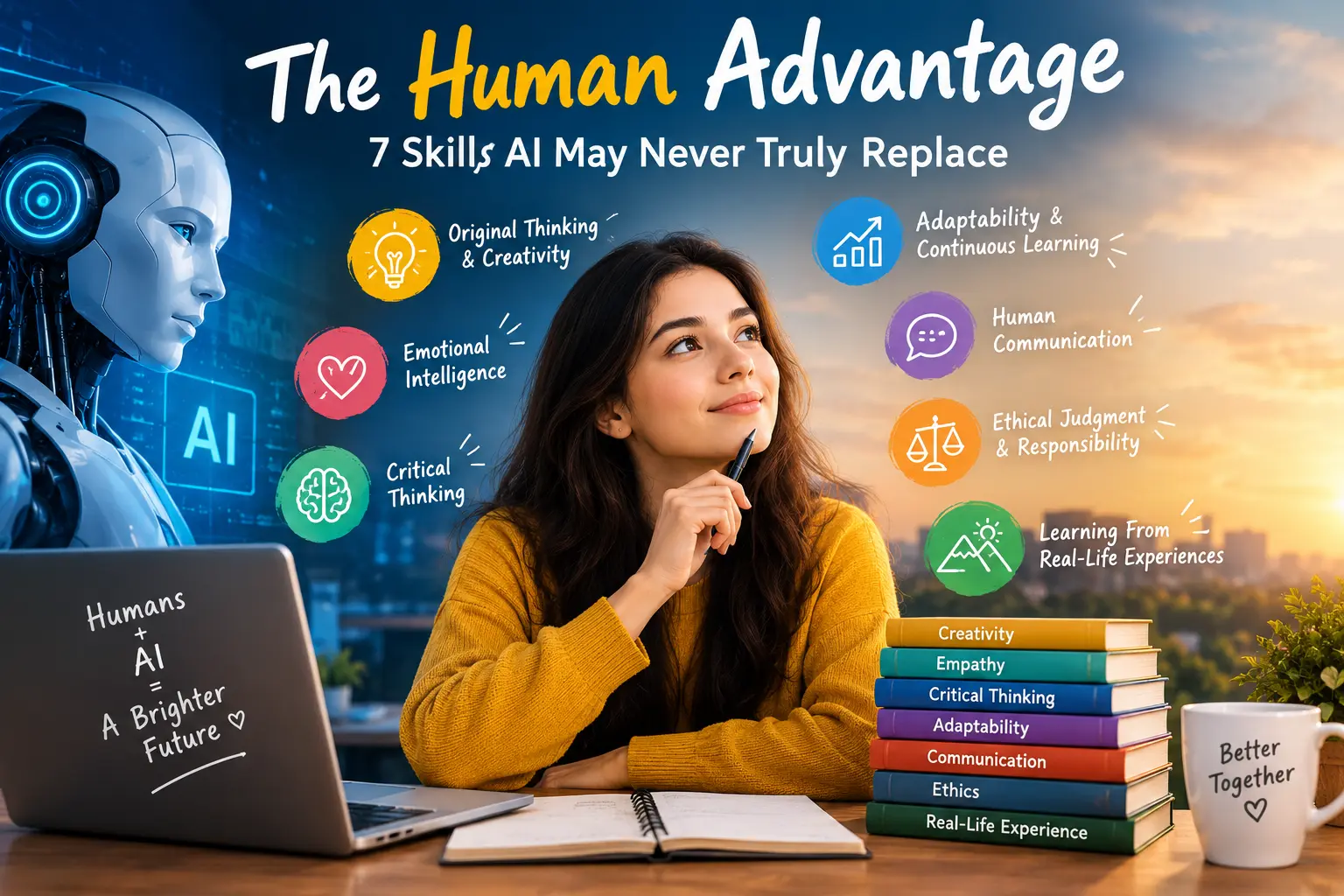
The Human Advantage: 7 Skills AI May Never Truly Replace
Artificial intelligence is changing the way we work, learn, communicate, and solve problems. From writing articles to creating digital artwork, AI tools can now perform tasks that once required hours of human effort.
But here is an interesting question: If machines can do so much, what makes human beings truly valuable?
The answer goes beyond intelligence. Human creativity, emotional understanding, personal experiences, and the ability to find meaning in ordinary moments give people a unique advantage.
In this article, we will explore seven human skills that can help you stand out in an increasingly AI-driven world.
Original Thinking and Creativity
AI can generate thousands of ideas in seconds, but creativity is not simply about producing more ideas. It is about noticing something others overlook and connecting seemingly unrelated experiences.
For example, an entrepreneur might turn a common problem in their neighborhood into a successful business idea. That idea could begin with a simple conversation or a personal frustration.
How to develop this skill: Observe everyday problems, keep a notebook of unusual ideas, and experiment with different solutions.
Emotional Intelligence
Understanding emotions is an important part of building meaningful relationships. A person who recognizes when a colleague feels discouraged or when a friend needs support can respond with empathy rather than just information.
AI can recognize emotional patterns and produce supportive language, but genuine human relationships also involve shared experiences, trust, and personal responsibility.
How to develop this skill: Listen without interrupting, ask thoughtful questions, and try to understand perspectives different from your own.
Critical Thinking
Information is everywhere, but reliable information is not always easy to identify. AI systems can occasionally produce incorrect or misleading answers, which makes independent judgment essential.
Critical thinkers ask questions such as:
Is this information supported by evidence?
What assumptions are being made?
Are there alternative explanations?
What could happen if this advice is followed?
These questions help people make better decisions instead of accepting every answer at face value.
Adaptability and Continuous Learning
Technology changes quickly. Skills that are valuable today may need to be updated tomorrow.
Instead of fearing new tools, adaptable people learn how to use them. A writer can learn AI-assisted research, a teacher can explore interactive learning tools, and a small business owner can automate repetitive tasks.
The goal is not to compete with every new technology. It is to learn how to use technology effectively.
Human Communication
Great communication involves more than choosing the right words. Timing, context, body language, cultural awareness, and personal trust can all influence how a message is understood.
People who explain complex ideas simply, resolve disagreements respectfully, and build genuine professional relationships have an advantage in almost every industry.
Try this: Explain one difficult idea each day in simple language, as if you were teaching it to a beginner.
Ethical Judgment and Responsibility
Not every decision can be made by following a formula. Real situations often involve competing priorities, uncertainty, and consequences for other people.
For example, a business might have to choose between a cheaper solution and one that protects customer privacy more effectively.
AI can help identify possible outcomes, but humans still need to consider values, accept responsibility, and decide what trade-offs are appropriate.
Learning From Real-Life Experiences
Life teaches lessons that are difficult to understand through theory alone. Starting a small project, facing rejection, helping someone through a difficult time, or recovering from a mistake can change how a person thinks.
These experiences build practical judgment and provide stories, insights, and perspectives that make communication more personal.
You do not need extraordinary experiences to learn something valuable. Sometimes, paying closer attention to ordinary life is enough.
How to Combine Human Skills With AI
Rather than treating AI as an enemy, consider it a tool that can support your abilities.
Here is a simple approach:
Use AI to brainstorm ideas and organize information.
Check important facts before publishing or acting on them.
Add your own examples, opinions, and experiences.
Review the result for accuracy, clarity, and originality.
Take responsibility for the final work.
This approach allows technology to handle some repetitive tasks while you focus on judgment, creativity, and meaningful decisions.
Conclusion
The future will not necessarily belong to people who can perform every task faster than a machine. It may favor those who combine technological knowledge with creativity, empathy, critical thinking, and adaptability.
You do not have to become an expert in everything. Start by improving one skill, using new tools thoughtfully, and staying curious about the world around you.
In a world where machines can generate answers, the ability to ask meaningful questions may become one of our greatest advantages.


