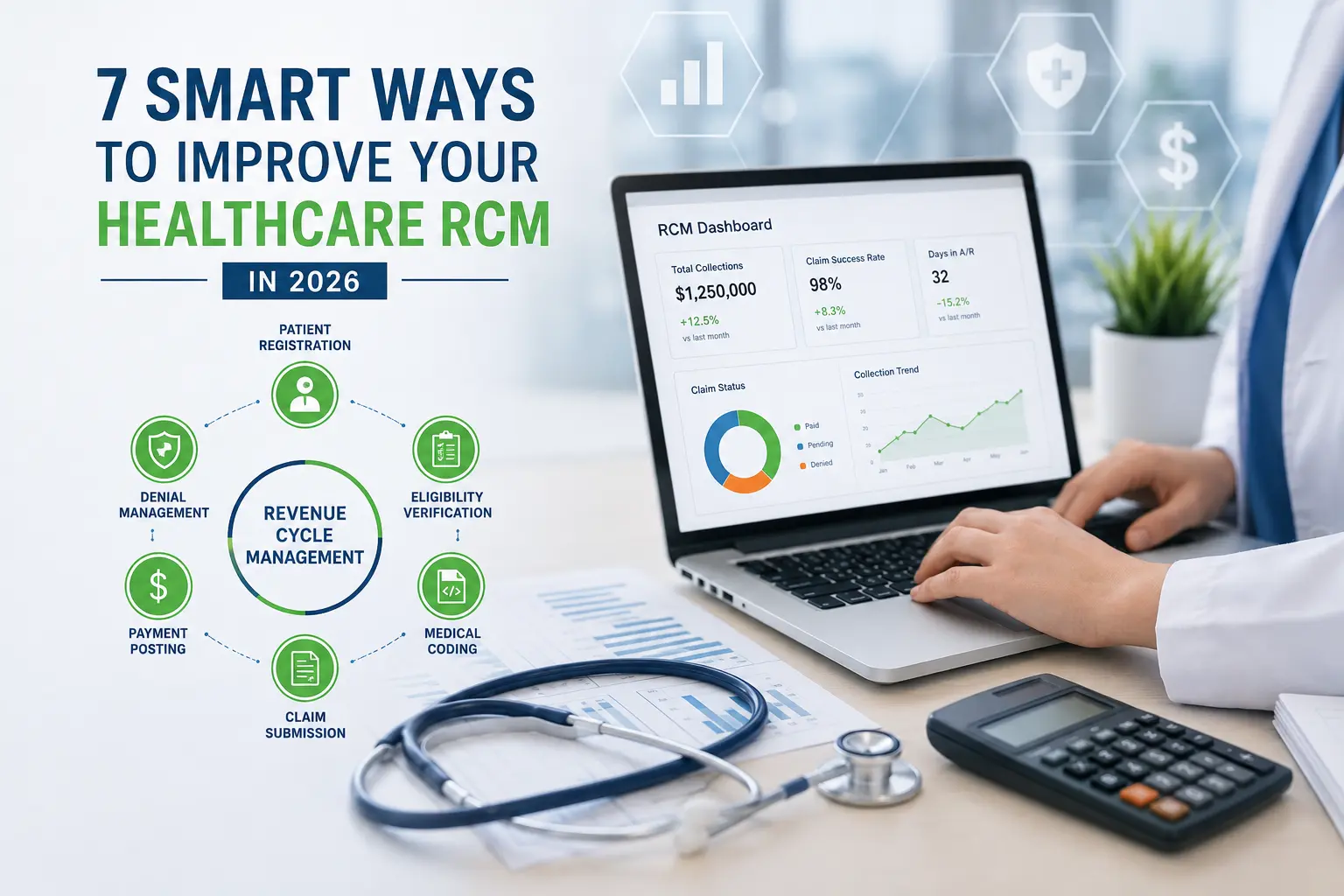
Managing a healthcare practice involves much more than providing quality patient care. Behind every successful practice is an efficient financial process that keeps claims moving, payments coming in, and administrative work under control. This is where Healthcare Revenue Cycle Management becomes essential.
Effective Healthcare Revenue Cycle Management helps healthcare organizations reduce billing errors, improve claim accuracy, accelerate reimbursements, and strengthen overall financial performance. As technology and payer requirements continue to evolve in 2026, medical practices need smarter strategies to manage their revenue cycle.
Here are seven practical ways to improve Healthcare Revenue Cycle Management and create a more efficient medical billing operation.
Verify Patient Eligibility Before Every Visit
Insurance eligibility verification is one of the most important steps in Healthcare Revenue Cycle Management. Incorrect or outdated insurance information can result in rejected claims, delayed payments, and unexpected patient balances.
Before providing services, practices should verify important details such as:
- Insurance coverage status
- Deductibles and copayments
- Coinsurance requirements
- Authorization requirements
- Coverage limitations
- Patient demographic information
Accurate eligibility verification helps practices identify potential payment issues before the claim is submitted and supports a stronger Healthcare Revenue Cycle Management process.
Improve Medical Coding Accuracy
Accurate medical coding plays a major role in successful reimbursement. Incorrect ICD-10, CPT, or HCPCS codes can cause claim denials, payment delays, and compliance concerns.
Healthcare organizations should make sure coding teams stay updated with current coding guidelines and payer requirements. Regular audits can also help identify recurring coding mistakes.
Professional coding support improves claim accuracy and strengthens the overall Healthcare Revenue Cycle Management workflow while allowing physicians and office staff to focus more on patient care.
Automate Routine Billing Tasks
Manual billing processes can consume valuable staff time and increase the possibility of human errors. Automation can simplify repetitive tasks such as claim submission, payment posting, eligibility verification, and claim tracking.
Modern technology can make Healthcare Revenue Cycle Management more efficient by helping practices monitor claims and identify problems faster. Automation does not replace experienced billing professionals; instead, it gives them better tools to work efficiently.
By reducing repetitive administrative work, healthcare organizations can improve productivity and create a smoother Healthcare Revenue Cycle Management process.
Strengthen Denial Management
Claim denials can significantly affect a healthcare practice’s cash flow. Instead of simply correcting denied claims, practices should identify why denials are happening in the first place.
Common denial causes include:
- Incorrect patient information
- Coding errors
- Missing documentation
- Authorization issues
- Eligibility problems
- Duplicate claims
- Incorrect payer information
Tracking denial trends allows billing teams to identify patterns and address the root causes. A proactive denial management strategy can reduce future denials and improve the percentage of claims paid on the first submission.
Strong denial management is therefore a critical part of successful Healthcare Revenue Cycle Management.
Focus on Faster Claims Submission
The longer a claim takes to reach the payer, the longer a practice may have to wait for reimbursement. Timely claim submission is therefore an important part of a healthy revenue cycle.
Practices should review their workflow from patient registration through claim submission. Any unnecessary delays should be identified and eliminated.
Clean claims submitted quickly can improve payment turnaround, reduce delays, and support better Healthcare Revenue Cycle Management performance.
Monitor RCM Performance With Data
Healthcare organizations cannot improve what they do not measure. Tracking key performance indicators can provide valuable insight into the health of the revenue cycle.
Important Healthcare Revenue Cycle Management metrics include:
- Clean claim rate
- Claim denial rate
- Days in accounts receivable
- Net collection rate
- First-pass resolution rate
- Average reimbursement time
- A/R aging
Reviewing these metrics regularly can help management identify weaknesses and make informed decisions.
For example, if denial rates suddenly increase, the practice can investigate the cause before the problem affects a larger number of claims. Data-driven decisions can make Healthcare Revenue Cycle Management more predictable and effective.
Partner With an Experienced Medical Billing Company
Managing every part of the revenue cycle internally can be challenging, particularly for growing practices. Outsourcing selected RCM services can provide access to experienced billing professionals, advanced technology, and established workflows.
A professional RCM partner can assist with services such as medical billing, coding, eligibility verification, denial management, payment posting, and accounts receivable follow-up.
The right partner can help reduce administrative pressure while improving financial visibility and strengthening Healthcare Revenue Cycle Management performance.
Why Healthcare Revenue Cycle Management Matters in 2026
The healthcare industry continues to become more complex. Payer requirements, coding updates, patient financial responsibility, and technology changes all affect the revenue cycle.
A strong Healthcare Revenue Cycle Management strategy allows practices to respond to these challenges more effectively. Instead of waiting for billing problems to occur, organizations can use data, automation, accurate documentation, and proactive workflows to prevent issues before they become expensive.
Improving Healthcare Revenue Cycle Management is not only about collecting more money. It is also about creating a smoother experience for patients, reducing unnecessary administrative work, and building a financially sustainable healthcare organization.
Conclusion
An efficient Healthcare Revenue Cycle Management process is essential for the long-term success of a healthcare practice. From verifying insurance eligibility and improving coding accuracy to automating billing tasks and strengthening denial management, small improvements across the RCM process can produce meaningful results.
By monitoring performance, adopting smarter technology, and working with experienced billing professionals, healthcare organizations can reduce revenue leakage and improve their overall financial performance.
For practices looking to strengthen their Healthcare Revenue Cycle Management strategy in 2026, focusing on accuracy, efficiency, automation, and proactive revenue management is a strong place to start.
FAQs
What is Healthcare Revenue Cycle Management?
Healthcare Revenue Cycle Management is the process of managing a patient’s financial journey from registration and insurance verification through claims processing, payment collection, and accounts receivable follow-up.
How can Healthcare Revenue Cycle Management reduce claim denials?
Effective Healthcare Revenue Cycle Management can reduce denials through accurate patient information, eligibility verification, proper medical coding, complete documentation, timely claim submission, and proactive denial management.
Should medical practices outsource Healthcare Revenue Cycle Management?
Outsourcing Healthcare Revenue Cycle Management can be beneficial for practices that want access to experienced billing professionals, technology, and specialized RCM expertise while reducing the administrative workload on their internal staff.


