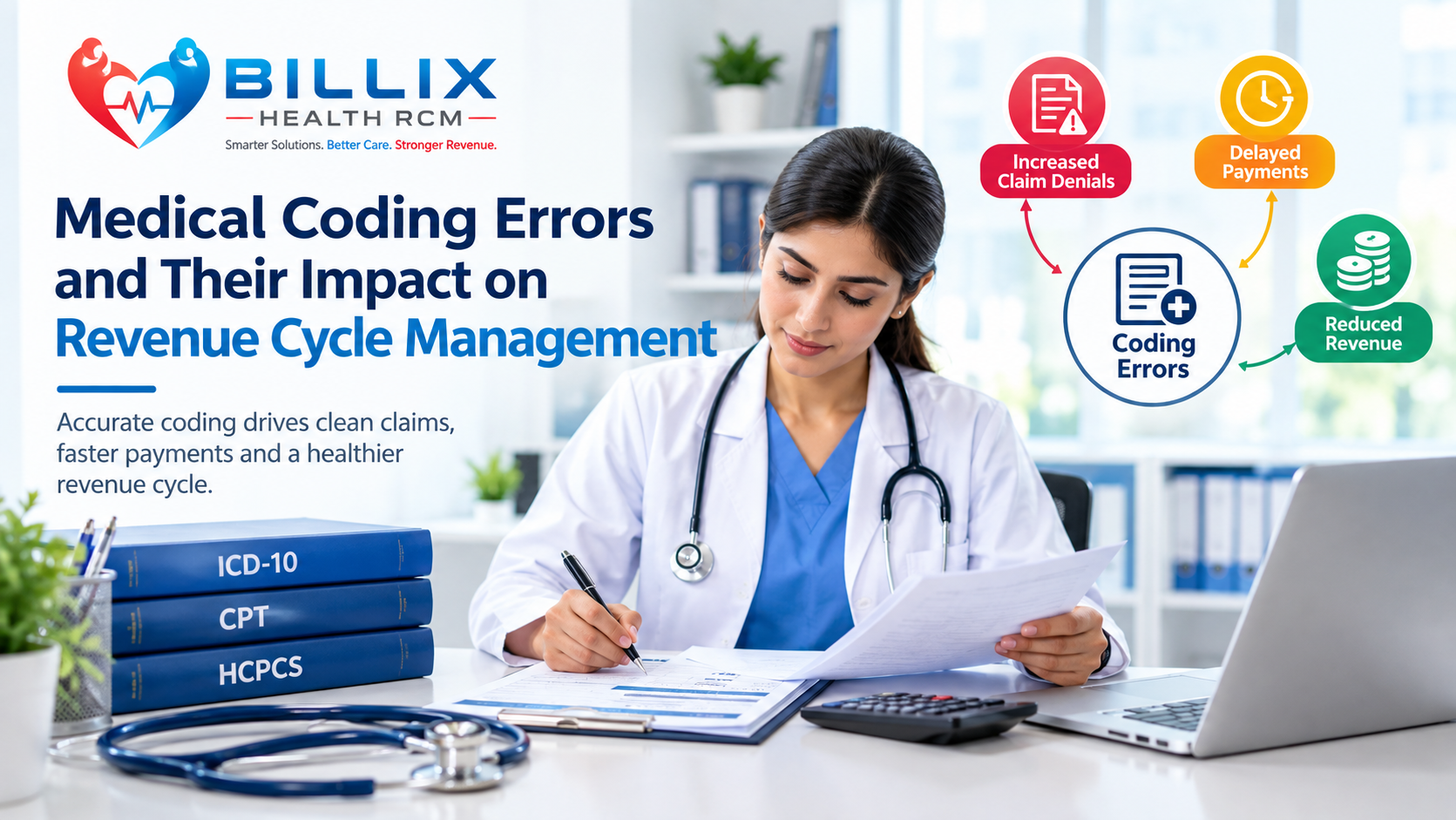
Medical coding is one of the most important parts of the healthcare revenue cycle. Accurate coding helps healthcare providers submit clean claims, receive timely reimbursements, and maintain a healthy cash flow. However, even small medical coding errors can create significant financial and operational challenges for a healthcare practice.
Incorrect codes, missing information, inaccurate modifiers, and documentation inconsistencies can lead to claim rejections, denials, delayed payments, and unnecessary administrative work. Over time, these problems can have a direct impact on a provider’s overall revenue cycle management (RCM) performance.
Understanding the most common coding mistakes and taking steps to prevent them can help healthcare organizations improve claim accuracy and protect their revenue.
What Are Medical Coding Errors?
Medical coding errors occur when the diagnosis, procedure, or service provided to a patient is not translated correctly into the appropriate medical codes.
Medical coders use standardized code sets to communicate patient diagnoses and healthcare services to insurance companies and other healthcare organizations. When the wrong code is submitted or important coding information is missing, the payer may reject or deny the claim.
Common examples include:
- Using an incorrect diagnosis code
- Selecting the wrong procedure code
- Using an inappropriate modifier
- Missing required modifiers
- Upcoding or undercoding
- Incorrect use of ICD-10, CPT, or HCPCS codes
- Coding services that are not supported by documentation
- Failing to update codes when coding guidelines change
These errors may appear minor, but their financial impact can become substantial when they occur across hundreds or thousands of claims.
How Medical Coding Errors Affect Revenue Cycle Management
A successful revenue cycle depends on accurate information moving through every stage of the billing process. Coding is a critical link between clinical documentation and claim submission.
When coding errors occur, they can disrupt the entire process.
Increased Claim Denials
One of the biggest consequences of coding errors is an increase in claim denials.
Insurance companies review submitted claims to determine whether the diagnosis and services are appropriately coded and supported by documentation. If the information does not meet payer requirements, the claim may be denied.
Frequent coding-related denials can reduce the percentage of clean claims and force billing teams to spend additional time researching, correcting, and resubmitting claims.
Delayed Payments
A coding error can prevent a claim from being processed correctly on the first submission.
Instead of receiving reimbursement within the normal payment cycle, the provider may need to correct the claim and submit it again. This extends the time between providing a service and receiving payment.
For healthcare practices, delayed reimbursement can create cash-flow pressure and make financial planning more difficult.
Higher Administrative Costs
Every denied or rejected claim requires additional work.
Billing staff may need to:
- Identify the reason for the denial.
- Review the patient’s documentation.
- Determine the coding problem.
- Correct the claim.
- Resubmit the claim.
- Follow up with the payer.
- Monitor the claim until payment is received.
When coding accuracy is poor, healthcare organizations spend more time managing avoidable issues instead of focusing on other important revenue cycle activities.
Lost Revenue
Not every denied claim is successfully recovered.
Some claims may become difficult to collect because of filing deadlines, missing documentation, eligibility issues, or repeated billing errors. If these claims are not resolved properly, the healthcare provider may lose revenue for services that were already delivered.
This is why preventing coding errors is generally more efficient than relying only on denial recovery.
Compliance Risks
Accurate coding is not only about getting paid. It is also an important part of healthcare compliance.
Incorrect coding can create compliance concerns when submitted codes do not accurately represent the services provided or are not supported by medical documentation.
Healthcare organizations should therefore focus on coding accuracy, proper documentation, regular audits, and ongoing education for coding and billing teams.
ry.
Common Medical Coding Mistakes Healthcare Providers Should Avoid
Incorrect Diagnosis Coding
The diagnosis code should accurately reflect the patient’s documented condition. Choosing a code that does not match the clinical documentation can result in claim issues and payer questions.
Incorrect Procedure Coding
Selecting the wrong CPT or HCPCS code can cause a claim to be rejected or denied. Coders should carefully review the service performed and the documentation before selecting the appropriate code.
Modifier Errors
Modifiers provide additional information about how or why a service was performed. Incorrect or missing modifiers can affect claim processing and reimbursement.
Because modifier requirements can vary depending on the service and payer, coding teams need to understand the applicable billing rules
Upcoding
Upcoding occurs when a higher-level service is reported than the documentation supports. This can create serious compliance and financial risks
Undercoding
Undercoding happens when a service is reported at a lower level than what was actually supported by the documentation. Although it may not create the same compliance concerns as upcoding, it can result in lost revenue.
Incomplete Documentation
Coding accuracy depends heavily on clinical documentation. If documentation does not clearly support the diagnosis or procedure, the coder may not be able to select the appropriate code.
How Professional Medical Billing Support Can Help
Managing coding, billing, claims, denials, and payer requirements internally can be challenging, especially for growing healthcare practices.
A professional medical billing and RCM partner can help providers create a more organized revenue cycle by reviewing claims, identifying billing issues, monitoring denials, and supporting timely reimbursement.
At Billix Health RCM, the goal is to help healthcare providers improve their revenue cycle while reducing avoidable billing problems. From medical billing and coding to denial management and analytics, an integrated approach can help practices maintain greater control over their financial performance.
Final Thoughts
Medical coding errors can have a much bigger impact than a single incorrect claim. Repeated coding mistakes can increase denials, delay reimbursements, raise administrative costs, and ultimately affect a healthcare practice’s revenue.
The best approach is to identify errors early, strengthen documentation and coding processes, conduct regular audits, and continuously monitor denial trends.
By making coding accuracy a priority, healthcare providers can build a cleaner claims process and create a stronger foundation for effective revenue cycle management.
If your practice is experiencing coding issues, claim denials, or reimbursement delays, professional RCM support can help identify the gaps and improve your billing workflow.


