Revenue Cycle Management Trends 2026: What Healthcare Providers Need to Know
Healthcare revenue cycle management (RCM) is changing rapidly. Rising administrative costs, complex payer requirements, increasing denial risks, and advances in artificial intelligence are pushing healthcare providers to rethink how they manage billing and collections.
In 2026, successful healthcare organizations are moving beyond traditional medical billing. They are adopting smarter revenue cycle management strategies designed to improve claim accuracy, reduce denials, accelerate reimbursements, and create better financial visibility.
For medical practices, hospitals, specialty groups, and other healthcare providers, understanding the latest RCM trends can make a significant difference in financial performance.
What Is Revenue Cycle Management?
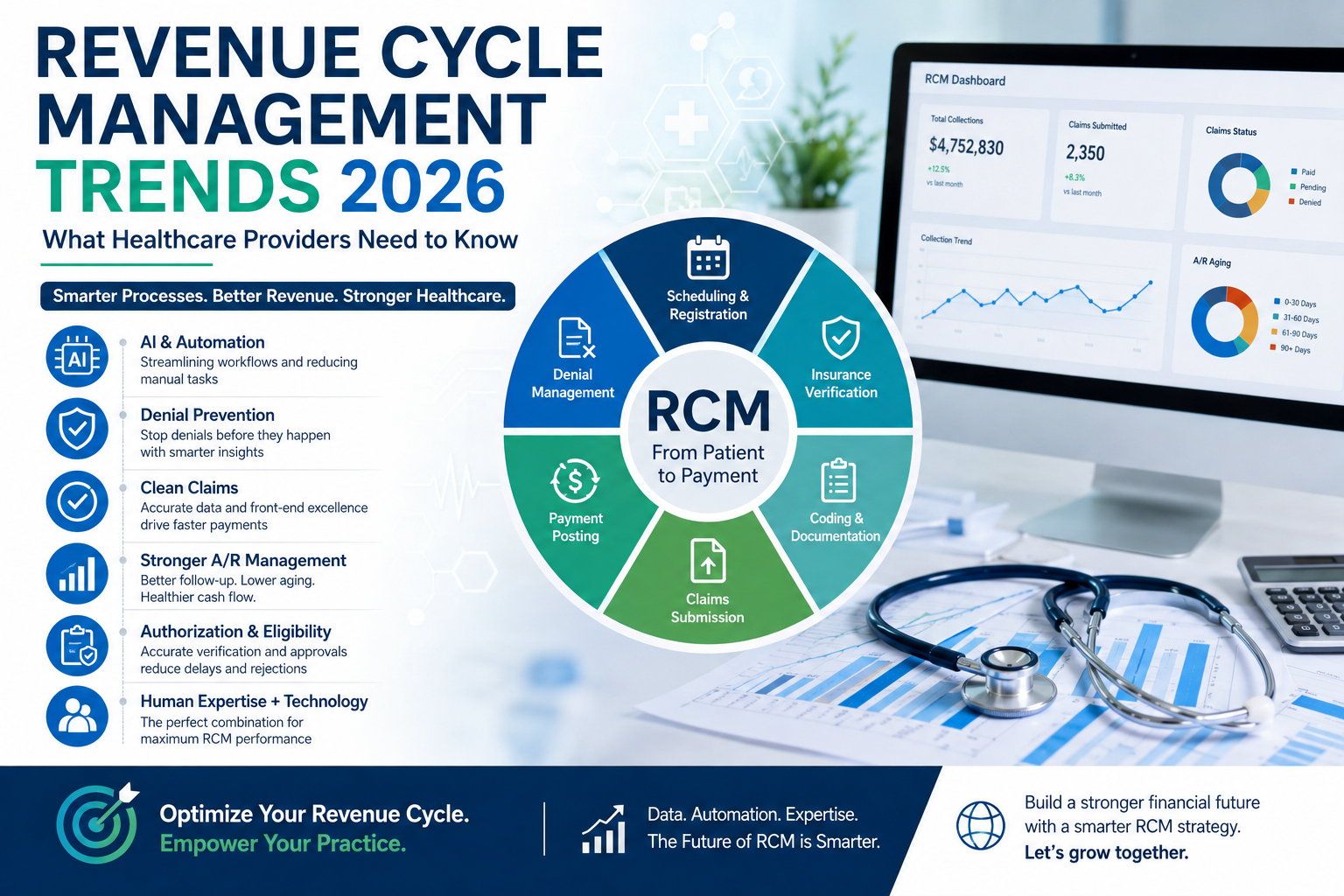
Revenue Cycle Management (RCM) is the complete financial process that begins when a patient schedules an appointment and continues through insurance verification, medical coding, claim submission, payment posting, denial management, and collections.
An effective healthcare revenue cycle helps organizations maintain healthy cash flow while reducing billing errors and administrative inefficiencies.
A well-managed revenue cycle can help healthcare organizations:
- Reduce claim denials and rejections
- Improve billing accuracy
- Accelerate insurance payments
- Reduce outstanding accounts receivable
- Improve cash flow
- Reduce administrative workload
- Identify revenue leakage
- Improve overall financial performance
Because every stage of the revenue cycle is connected, a problem at the beginning of the process can create financial issues later.
Top Revenue Cycle Management Trends for 2026
1. AI and Automation Are Transforming Medical Billing
Artificial intelligence is becoming an increasingly important part of healthcare RCM. Providers are using AI-assisted technologies to automate repetitive processes, identify billing errors, analyze claims, and predict potential denials.
AI and automation can support areas such as:
- Insurance eligibility verification
- Claims processing
- Medical coding assistance
- Claim scrubbing
- Denial prediction
- Payment posting
- Accounts receivable analysis
- Prior authorization workflows
The goal is not simply to replace manual work. Instead, automation allows experienced billing professionals to focus on complex claims, payer issues, denial resolution, and revenue optimization.
2. Denial Prevention Is Becoming More Important Than Denial Recovery
Many practices focus heavily on fixing denied claims after they occur. However, a more effective RCM strategy is to identify the causes of denials before claims are submitted.
Common causes of claim denials include:
- Incorrect patient information
- Insurance eligibility issues
- Coding errors
- Missing documentation
- Authorization problems
- Incorrect modifiers
- Medical necessity issues
- Payer-specific requirements
Modern RCM workflows increasingly use data and analytics to identify patterns and flag high-risk claims before submission. This proactive approach can reduce rework and help healthcare providers protect revenue.
3. Clean Claims Are Critical for Faster Reimbursement
A clean claim contains accurate information and meets payer requirements, allowing it to be processed without unnecessary delays or corrections.
Improving clean claim performance starts before the claim reaches the payer.
Healthcare organizations should focus on:
- Accurate patient registration
- Insurance verification
- Correct medical coding
- Complete documentation
- Appropriate authorization
- Automated claim scrubbing
- Timely claim submission
The stronger the front-end process, the fewer problems the billing team has to solve later.
4. Healthcare Providers Are Paying More Attention to A/R Management
Accounts receivable, commonly called A/R, represents money that is still owed to a healthcare organization.
A growing A/R balance can negatively affect cash flow and make it more difficult for a practice to maintain financial stability.
Effective A/R management includes:
- Regular aging analysis
- Timely payer follow-up
- Denial tracking
- Patient balance follow-up
- Underpayment identification
- Appeal management
- Prioritization of high-value accounts
Instead of simply measuring the total A/R balance, healthcare organizations should analyze why accounts remain unpaid and where revenue is getting stuck.
5. Prior Authorization and Eligibility Verification Remain Key RCM Challenges
Insurance verification and prior authorization are important front-end components of the healthcare revenue cycle.
When eligibility or authorization information is incorrect, a claim may be delayed or denied even when the medical service itself was appropriate.
That is why healthcare providers should focus on accurate verification before services are delivered.
6. Human Expertise Still Matters in an Automated RCM Environment
Technology is changing healthcare billing, but experienced RCM professionals remain essential.
AI and automation can identify patterns, process information, and reduce repetitive tasks. However, complicated payer rules, unusual claims, appeals, documentation issues, and compliance considerations often require professional judgment.
This hybrid approach can provide the efficiency of automation while maintaining the human expertise required for complex revenue cycle challenges.
How Can Healthcare Providers Improve Their RCM in 2026?
Healthcare organizations can strengthen their revenue cycle by focusing on several practical areas.
Review Your Current Billing Workflow
Identify where claims are experiencing delays, rejections, denials, or payment issues. Understanding where revenue gets stuck is the first step toward improving the overall process.
Track Key RCM Metrics
Important revenue cycle management metrics may include:
- Clean claim rate
- Denial rate
- Days in A/R
- Net collection rate
- Gross collection rate
- A/R aging
- Payment turnaround time
Identify the Root Cause of Denials
Do not treat every denial as an isolated problem. Look for patterns by payer, provider, procedure, diagnosis, location, or billing workflow.
Strengthen Front-End Processes
Accurate registration, eligibility verification, authorization, and documentation can prevent many downstream billing problems.
Use Automation Strategically
Automate repetitive processes where technology can improve speed and consistency, while keeping qualified professionals involved in complex decisions.
Why Outsourced RCM Services Can Help
Managing the entire revenue cycle internally can be challenging, especially for growing healthcare practices and organizations with limited administrative resources.
An experienced medical billing and RCM partner can provide specialized support across areas such as:
- Medical billing
- Medical coding
- Claims management
- Denial management
- A/R follow-up
- Payment posting
- Eligibility verification
- Prior authorization
- Revenue cycle reporting
Outsourcing can help healthcare providers reduce administrative pressure and allow internal teams to focus more on patient care and practice operations.
The Future of Healthcare Revenue Cycle Management
The future of RCM is becoming more data-driven, automated, and proactive.
Instead of waiting for claims to be denied or accounts to become seriously overdue, healthcare organizations are moving toward systems that identify potential problems earlier.
AI-assisted workflows, predictive analytics, automation, stronger front-end processes, and experienced RCM teams are likely to play an increasingly important role throughout 2026 and beyond.
However, technology alone does not guarantee better financial performance. Healthcare organizations need well-designed workflows, accurate data, compliance-focused processes, and experienced professionals working together.
Conclusion
Revenue Cycle Management is no longer simply a back-office billing function. It is an important part of a healthcare organization's financial and operational strategy.
In 2026, providers that focus on denial prevention, clean claims, automation, A/R management, accurate eligibility verification, and data-driven decision-making can put themselves in a stronger position to protect revenue and improve cash flow.
If your current billing process is experiencing frequent denials, delayed payments, growing A/R, or administrative challenges, reviewing your RCM workflow can be an important first step toward improving financial performance.
Frequently Asked Questions About Revenue Cycle Management
What is Revenue Cycle Management?
Revenue Cycle Management is the complete financial process of managing healthcare revenue, from patient registration and insurance verification through medical billing, claims processing, payment posting, denial management, and collections.
What are the major RCM trends in 2026?
Major RCM trends in 2026 include AI and automation, proactive denial prevention, clean claim optimization, stronger accounts receivable management, improved eligibility verification, prior authorization workflows, and combining technology with experienced RCM professionals.
How can healthcare providers reduce claim denials?
Healthcare providers can reduce claim denials by improving patient registration, verifying insurance eligibility, obtaining required authorizations, ensuring accurate medical coding, reviewing documentation, and using claim-scrubbing processes before submission.
Why should healthcare providers consider outsourcing RCM?
Outsourcing RCM can give healthcare providers access to experienced billing and coding professionals, denial management expertise, accounts receivable follow-up, eligibility verification, and reporting while reducing the administrative workload of internal teams.
Looking for Reliable Medical Billing & RCM Support?
A professional revenue cycle management partner can help identify revenue leaks, streamline billing workflows, reduce administrative burden, and build a more efficient path from patient service to payment.
Contact Billix RCM


