Introduction
physicians and staff focus on delivering quality patient care, healthcare practices must also manage insurance claims, medical coding, billing, payments, and patient accounts. When these processes are not properly managed, delayed reimbursements and claim denials can negatively affect cash flow.
This is where Healthcare Revenue Cycle Management becomes important. A well-managed revenue cycle helps healthcare providers improve billing accuracy, reduce payment delays, and maintain a healthier financial operation.
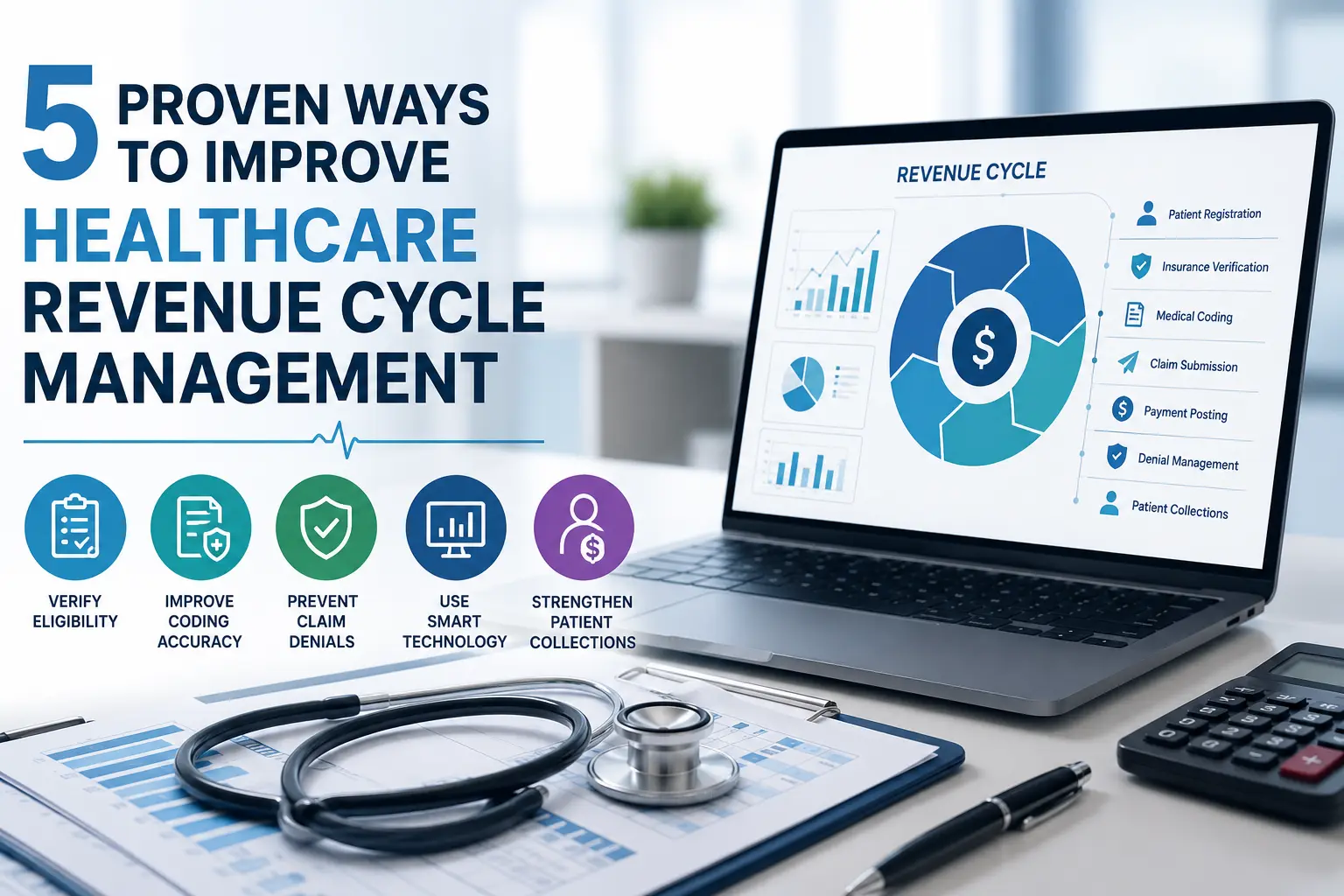
In this article, we explore five proven ways healthcare organizations can improve their revenue cycle and create a more efficient billing process.
Verify Patient Insurance Eligibility
One of the simplest ways to improve the revenue cycle is to verify insurance eligibility before providing services.
Incorrect insurance information, inactive policies, expired coverage, and missing authorization details can result in avoidable claim denials. By checking eligibility before the patient’s appointment, healthcare providers can identify potential coverage problems early.
An effective eligibility verification process should confirm:
- Patient demographic information
- Insurance coverage status
- Deductibles and copayments
- Coinsurance requirements
- Referral requirements
- Prior authorization requirements
Accurate eligibility verification helps reduce unexpected billing issues and gives patients a clearer understanding of their financial responsibility.
Improve Medical Coding Accuracy
Medical coding directly affects the accuracy of healthcare claims. Incorrect ICD-10, CPT, or HCPCS codes can cause claims to be rejected or denied by insurance companies.
Healthcare organizations should regularly review their coding processes and ensure that coding teams follow current payer and industry requirements.
Accurate coding helps healthcare practices:
- Reduce claim errors
- Prevent unnecessary denials
- Improve first-pass claim acceptance
- Support proper reimbursement
- Maintain compliance
Professional coding reviews can also identify recurring errors and provide opportunities for staff training.
Focus on Denial Prevention
Technology can make Healthcare Revenue Cycle Management faster and more efficient. Manual billing processes can create unnecessary delays and increase the possibility of human errors.
Modern RCM technology can help healthcare organizations automate tasks such as claim submission, eligibility verification, payment posting, reporting, and account follow-up.
Automation allows billing teams to spend less time on repetitive administrative work and more time addressing complex accounts that require human attention.
Healthcare organizations can also use analytics to monitor important performance indicators such as:
- Claim denial rates
- Days in accounts receivable
- Clean claim rates
- Collection rates
- Outstanding balances
- Payment turnaround time
These insights help management make better decisions and identify areas that need improvement.
Use Technology to Streamline Billing
Claim denials are one of the biggest challenges in healthcare revenue cycle management. Every denied claim requires additional time and effort to investigate, correct, and resubmit.
Instead of focusing only on recovering denied claims, healthcare providers should identify the reasons behind recurring denials.
Common causes include:
- Incorrect patient information
- Coding errors
- Missing documentation
- Eligibility problems
- Authorization issues
- Incorrect payer information
- Timely filing errors
By tracking denial trends, practices can identify their biggest revenue leaks and develop strategies to prevent similar problems in the future.
Strengthen Patient Billing and Collections
Claim denials are one of the biggest challenges in healthcare revenue cycle management. Every denied claim requires additional time and effort to investigate, correct, and resubmit.
Instead of focusing only on recovering denied claims, healthcare providers should identify the reasons behind recurring denials.
Common causes include:
- Incorrect patient information
- Coding errors
- Missing documentation
- Eligibility problems
- Authorization issues
- Incorrect payer information
- Timely filing errors
By tracking denial trends, practices can identify their biggest revenue leaks and develop strategies to prevent similar problems in the future.
Why Healthcare Revenue Cycle Management Matters
A strong revenue cycle does more than improve collections. It can support the overall financial health of a healthcare organization.
When billing, coding, eligibility verification, claims processing, denial management, and payment posting work together, practices can create a smoother financial workflow.
Effective Healthcare Revenue Cycle Management can help providers:
- Improve cash flow
- Reduce claim denials
- Accelerate reimbursements
- Reduce billing errors
- Improve operational efficiency
- Increase revenue visibility
- Give staff more time to focus on patients
How Billix Health RCM Can Help
Managing every part of the revenue cycle internally can be challenging, especially for growing healthcare practices. Professional RCM support can provide specialized expertise across billing, coding, claims management, denial management, and other revenue cycle functions.
Billix Health RCM helps healthcare organizations streamline their financial workflows and improve the overall efficiency of their revenue cycle.
By combining experienced professionals with efficient processes and technology, healthcare providers can focus more on patient care while maintaining better control over their revenue cycle.
Conclusion
Improving Healthcare Revenue Cycle Management does not require changing everything at once. Small improvements in eligibility verification, medical coding, denial prevention, billing automation, and patient collections can create meaningful financial results over time.
Healthcare providers that continuously monitor their revenue cycle and address problems before they become costly can improve efficiency, reduce payment delays, and build a stronger financial foundation.
The key is to treat revenue cycle management as an ongoing process rather than a one-time task. With the right strategies, technology, and professional support, healthcare organizations can create a more accurate, efficient, and profitable billing operation.
FAQs
What is Healthcare Revenue Cycle Management?
Healthcare Revenue Cycle Management is the process of managing the financial journey of a patient’s healthcare services, from appointment and insurance verification through claim submission, payment, and final collection.
How can RCM reduce claim denials?
RCM can reduce denials by improving eligibility verification, coding accuracy, documentation, authorization checks, claim submission, and denial tracking.
Why is medical coding important for RCM?
Accurate medical coding ensures that healthcare services are correctly represented on claims. Proper coding can reduce errors, prevent avoidable denials, and support appropriate reimbursement.
Can technology improve healthcare RCM?
Yes. Automation and analytics can streamline repetitive billing tasks, improve claim processing, track performance, and help identify revenue cycle problems more quickly.
Should healthcare practices outsource RCM?
Outsourcing can be useful for practices that lack the staff, technology, or expertise to efficiently manage billing and revenue cycle operations internally. A professional RCM partner can help improve processes and reduce administrative workload.


